DARPA is about to show the Navy’s shipbuilding plan is bull****

What is a powerful enough word to describe how the Navy’s shipbuilding plan is wasting thousands of man years and hundreds of billions of dollars on prejudices, untested assumptions, and bureaucratic inertia?

Luckily, DARPA is doing exactly what Congress created them to do way back in the Sputnik era: they are creating and protecting against technological surprise.  It would be fantastic if the Navy would jump on board and run phase 7 of this recently awarded DARPA contract.
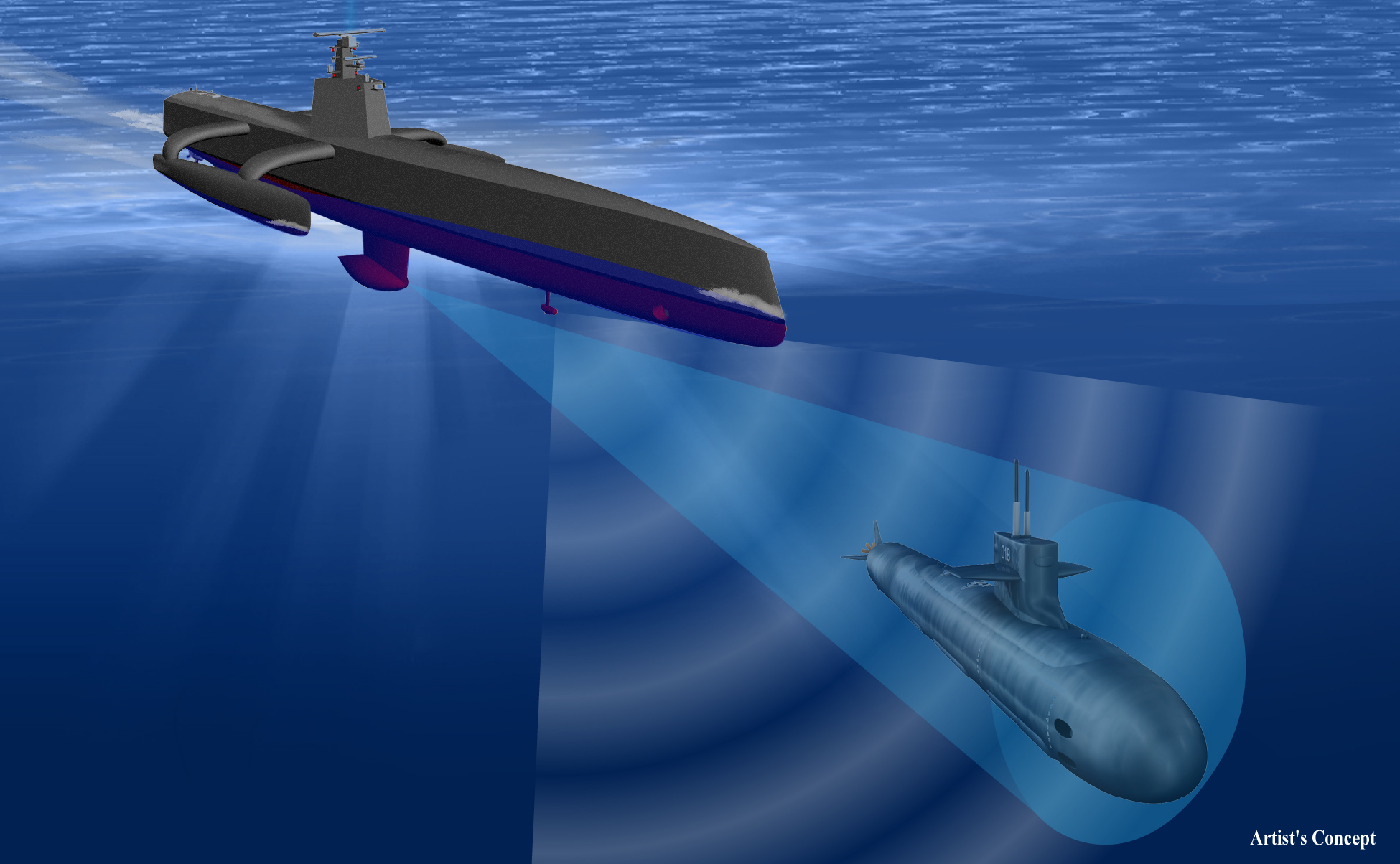
Source: DARPA

For those of you who do not come from defense, here is my take on the conflict between how the traditional Navy looks at ships and how DARPA and the embattled progressive minority in the Navy look at naval platforms including unmanned naval vessels.

The big, traditional Navy believes–and they have some experiences that gives rise to this belief–that naval ships ought to be flexible, broadly capable, and completely independent assets.  Take a modern Arliegh Burke class destroyer (DDG-51 class), the backbone of the U.S. fleet, as prime example.  It can deploy itself to the theater of operations, maneuver tactically, sense targets, make engagement decisions, engage the target, and retrograde tactically and strategically from the operation.  Moreover these ships can do almost every mission that they might be called on to do.  They are among the most capable ships at anti-air, surface, and anti-submarine warfare.  Additionally, they respond to things like pirates, search and rescue, and humanitarian relief operations.  Sounds pretty cool, right?  And it is.

However, being able to do everything comes with two main drawbacks.  First the ‘jack of all trades, master of none’ phenomenon is far more likely to be true because of design compromises in engineered systems than it is in people.  Second, adding all this capability costs a lot of money.  These destroyers are about $2B a copy and on the order of $1M/day to operate if you add in everything.  This means that we can only have so many and they cannot be everywhere.

DARPA and the progressive faction within the Navy believe that there is a fundamental change at hand in naval warfare.  Looking at how the Army/Air Force team conducts operations and the improvements in automation and communication technologies at sea, the progressives believe that the tradition of having big capital ships that do everything is outdated.

In contrast to the completely capable Navy platforms, Army units often only do one or two things.   Almost no Army units have strategic mobility.  Most can only do one or two things.  Intelligence units often only have the ability to sense. Artillery units only have the ability to do tactical maneuver and fire, but cannot sense.  Transport units move other units and equipment but cannot fire or sense; sometime they cannot even maneuver tactically.  The Army has huge staff units that do nothing but process information and make decisions to keep all these specialist pieces working in coordinated fashion on the battlefield.

DARPA and the naval progressives believe that a similar future is in store for the next globally dominant navy.  Which we hope will be, but does not have to be from the Unites States.  They envision swarms of inexpensive specialist vessels such as the one DARPA is building running around coordinated by a few manned ships.  The components of these fleets would be optimized to do a couple things well, be relatively–we’re talking about defense here–cheap, and be deployed in large numbers.

The reason that this is an urgent argument is that there is wide consensus within the U.S. Navy, across both the traditionalists and the progressives, that the Navy will not be able to meet its strategic obligations to our allies and American political leadership in a decade or two.  This is a ways off, but still within the service life of all the ships commissioned in the last decade.  The traditionalist seem to hope for a larger budget and the chance to ditch some missions (the Obama administration just took steps in this direction in their last budget), while the progressives say that if the Navy is receiving half of global naval spending it should be able to keep all its obligations by changing the way the Navy is organized.

The problem is that the traditionalists point out, correctly, that the progressives have not proved their scheme will work.  Then they say that they cannot cut even one ship or submarine which would build about a hundred of these future systems so that this alternate path can be tested.  It sounds to me like someone’s rice bowl is about to be overturned, and deep down they know it.

This is why DARPA’s ACTUV program is so important.  It puts at least one of these vessels out on the water so that people can see with their own eyes that they work.  They will be able to see the SAIC team turning around the vessel in record time and the ship controlled remotely and also sailing autonomously.  They will get to see that anti-submarine warfare works when done with a robot instead of hundreds of men on ships.  DARPA will start smashing the traditionalists reality, or at least put some big cracks in it.

Three cheers to DARPA for their continued work pushing the United States forward whether we all want to go or not!

My reflections on #AUVSI North America 2012

I got to spend two days at the Association for Unmanned Vehicle Systems International (AUVSI) North America 2012 trade show last week.  As a first pass, the industry continues to grow even as defense cuts start to put a damper on things.  Other domains besides air are also starting to look like real possibilities though their manufacturers don’t always see fit to join AUVSI.  There is still tremendous excitement about the FAA’s recent moves that seem to indicate real progress in the last year.  Privacy concerns are being taken seriously, hopefully early enough to nip the issue in the bud, because the safety issues seem to be close to resolved.

  • The show is bigger than ever with more and more companies in attendance.  Based on my entirely unscientific method of walking around the show and looking at the booths at random, it seems to me that there are more companies offering services and software, about the same number offering components and hardware, and many fewer trying a hawk new platforms.  I think this reflects the reality of customer budgets and also the maturity of the industry.  The show didn’t have quite the same clubby feel that I used to remember, but maybe that’s good as well.
  • There was real concern and real awareness of the image problems that our industry has.  AUVSI is still definitely focused on the air side of things, but ground and maritime are definitely on their radar.  There is real determination on the part of the association leadership, both professional and volunteer, to counteract the negative press that the industry has been getting.
  • The Brookings Institution and the American Civil Liberties Association (ACLU) were both in attendance to participate in a privacy forum.  The Brookings and ACLU seem to have a great deal of common ground with the AUVSI membership at large on at least the law enforcement uses of unmanned aircraft.  That is the fourth amendment is still in effect and the same sorts of procedures that govern manned aircraft data collection ought to govern unmanned aircraft data collection.  Further, most people here on both sides of the panel were far more personally concerned about being tracked by cellphone data than unmanned aircraft.
  • The show is still definitely defense centered.  However, there is a feeling in the air that the FAA will actually do something and get unmanned aircraft out in the airspace soon.  Lots more booths are starting to have material that touts civilian use and more thinking is going into what will happen after the FAA starts allowing unmanned aircraft in the airspace.  Personally, I’m still skeptical that FAA is going to meet its deadlines, but I am certainly hoping that they will.
  • Robotics is starting to be used more in the same breath with unmanned systems.  Most of the AUVSI education outreach efforts don’t talk about unmanned systems at all (except maybe in an acronym) but do talk about robotics education.  I think this is a really positive development.  I would like to see AUVSI, the RIA, SAE robotics, and the robotic medical device companies operate under some kind of shared banner.  We all have the same workforce concerns, similar regulatory concerns, and face the same kind of backlash whenever we try to introduce new applications.  I believe that there is strength in numbers and it is always great to get the back-up that the fallacious counter arguments being trotted out against your robotic application are the same ones trotted out against other robotic applications that have gone on to be successful.  Particularly when we go to Capitol Hill to try and get rules changed so that we can compete on level playing field with legacy systems I think that there is value in having the Boeings (NYSE:BA), Intuitives (NASDAQ:ISRG), and Schillings (acquired by FMC NYSE:FTI) of the world support each other.


Which VCs are investing in robotics? Here is the list.

the instrument of venture investment

source: SEC.gov

My overview of the Firms Behind the Hizook 2011 VC in Robotic List has graciously been published at Hizook.

Bottom line:  We don’t have a cadre of dedicated robotics investors, but we can get investment from the industries that serve as our customers.

I wish you all luck in getting some of that VC Cash.  …on second thought, no, actually, I don’t–I  wish you all luck in signing up major partners who will give you progress payments to complete your product without diluting your investment.

But whatever your situation I hope that you use the appropriate capital structure to make lots of robots, lots money, and lots of good in the world.

Robotics capital intensive?! What are you smoking? Don’t believe it.

Robotic manufacturing is not capital intensive, contrary to the popular wisdom.  (Looking at you HBS.)

Unless someone can bring data to the contrary, we should treat this issue as thoroughly decided against the  conventional wisdom.  As we saw previously, robotics companies do not need a lot of fixed assets.  Now, we will see why people who blithely repeat the conventional wisdom that robotics companies are capital intensive are wrong–even if they claim robotics companies are hiding their true use of capital.

First off, robotics companies’ balance sheets look like technology companies’–the internet kind, not the aerospace/industrial kind.  Robotics companies have lots of cash and relatively little else.

Second, robotics companies have gross margins that even companies that don’t make stuff would envy.  The robotics gross margin would probably be even higher if iRobot and Aerovironment were not defense contractors.   There is a lot of pressure to bury as much expense as allowed into the cost of goods due to defense contract rules.   Intuitive and Cognex’s margins are around 75%.  They are even beating Google on gross margin!

Although, it does appear that robotics companies have a bit longer cash conversion cycle than the basket chosen for comparison here, their cash cycle appears to be in line with other complex manufacturers.  Plus, the robotics companies are holding so much cash their management may just not really care to push the conversion cycle down.

Look at the cash required to sell aircraft though!  Manned or unmanned it looks like it takes forever to get paid for making planes.

Although robotics companies have physical products, the value of a robot is in the knowledge and information used to create it and operate it.  The materials are nothing special.  Consequently, these companies look like part of the knowledge economy–few real assets, lots of cash, and huge attention to their workforce.   Next time someone tells you robotics companies are capital intensive, ask them to share what they’re smoking–it’s probably the good stuff–because they aren’t using data.

One thing that a venture capitalist may mean when he says that robotics is capital intensive is that it generally takes a long time and lots of money to develop a viable product in robotics.  This may be true, but it is not really the same thing as being capital intensive.   This observation should cause a lot of soul-searching within our industry.  What the venture capitalist is telling us is that we–as an industry–cannot reliably manage our engineering, product development, and business structures to produce financial results.

This is why the conventional wisdom is dangerous.  It suggests that the lack of investors, money, and talent flowing into our industry isn’t our fault and there’s not much we can do about it.  That is what needs to change in robotics.  We need to get better at management.  We need to start building companies quicker and producing returns for our investors.  If we do that the money, talent, and creativity will start pouring into industry.  Then robotics can change the world.

Notes on Data and Method
Data Source: Last 10-k

Method:

Accounts Receivable = All balance sheet accounts that seem to be related to a past sale and future cash, so accounts receivable plus things like LinkedIn’s deferred commissions.

Cash + Investments = All balance sheets I could identify as being financial investments not required to operate.   Assume all companies require zero cash to operate.

Did not account for advances in cash conversion cycle.

U.S. Robotic Stocks: Speculators Wanted (the real kind, not the financial kind)

The first part of the robotic stock tracker is up.  The index is coming!

First observation:  It is amazing how volatile robotic stocks are and how much idiosyncratic behavior each stock has exhibited since the start of the year.   With this much volatility, one would expect robotic stocks to produce market beating performance over the long run, but they certainly haven’t done it so far this year.  In the short run, it is very difficult to value real assets that have uncertain financial prospects.  In the long run, I’m banking on an extremely bright future, powered by robots.

A response to Singer

I must be an Aristotelian active soul, because I have no patience for those who hold themselves up as philosophers but suggest no way to actually live in the world.  I have a new post up on Hizook taking the leading intellectual on drones to task for sloppy reasoning–then I suggest a realistic path forward.

http://www.hizook.com/blog/2012/07/23/pw-singer-wastes-opportunity-atlantic

Hizook 2011 Notes

Be on the look out for a forthcoming analysis of the Hizook 2011 VC in Robotic List on Hizook about the funds that invest in robotics.   I’m publishing my research notes here so they don’t foul up the article.  Most of this was sourced from company websites, CrunchBase, local media, or whatever I could find using Google with my limited attention span, I think I even remembered to cite a few as I was making this.

The only thing I’d really like to call your attention to, dear reader, is the complete lack of transparency in the private markets.  You’ll see that there are places I could find a round, or an amount, or fund but nothing else.  A lot of the poor citation is me trying to find a better source.  Private transactions have no organized data so if this can be the faintest candle for finding funding for robotics, then I’ve done my job.

As always, I’d love feedback.  I’m hungry for data!

More Hacker Spaces! Techshop coming to Pittsburgh

Techshop is coming to Pittsburgh.  This will be a great addition to Pittsburgh’s DIY / Hacker culture–which has a slightly different flavor in Pittsburgh because-unlike the big coastal cities that are ‘rediscovering’ the idea of building stuff-Pittsburgh is a city that never stopped thinking of itself as working, industrial city.   On a personal level, I’m excited that Techshop is coming to Pittsburgh with a focus on veterans.

I’m not sure how we should view these kinds of DIY/Hacker spaces in terms of the robotics ecosystem.  Off the top of my head, I can’t think of any successful start-ups that got their start in these kinds spaces.  If you look at the hacker space websites, the kinds of projects that they tout as commercial successes are more in the consumer device space (e.g. artistic iPhone docks)  as opposed to commercial robotics.  On the other hand, they seem to be a good marker of the kind of culture that builds robots.  So whether this is indicative or causative of a great robotics scene, welcome to Pittsburgh, Techshop.

As an aside: I’ve updated the cluster comparison with a few of these developments and more DIY/Hackerspaces.  There are links in the cluster comparison to several resources in this arena.

Pittsburgh Robotics: Who is missing?

Our AUVSI chapter finally has a mini-directory of the companies and institutions (both AUVSI members and not) who participate in the Pittsburgh robotics community.  Who is missing?  Any institutions left out?

http://www.auvsi.org/Pittsburgh/PittsburghRobotics/

Where are the Ops Companies?

Really where are they?  Given how many companies are  building some form of robot it seems like there should be some proportionally greater number of companies out there forming to implement, service, and operate these robots.  Where are they?

Frank Tobe isn’t finding a lot of them forming in his start-up list.  Even the RIA seems to have fewer integrators than suppliers.  AUVSI has many more Lockheeds and Insitus than VT Services.  One could make a case that this is characteristic of the peculiar industries that we’re looking at.  The robotic counter example is perhaps the ROV industry which routinely provides the ROV as a packaged service to the off-shore oil and gas industry.  But most consumer robotics are still selling to early adopters.  Our consumer customers are all people who want tech for tech’s sake, not to mainstream customers that are just looking to solve a problem.

Think about other complex goods in our economy.  Computers have a vast cottage industry associated with servicing and maintaining them which is probably as big or bigger than the software industry proper.  All vehicle industries whether air, ground, or sea have vastly more businesses in the business of selling the services than engaged in construction of the vehicles–even if constructors do manage to capture a large share of the total revenues of the industry.

I think our industry has a problem.  I’ve talked to people at the oil and gas majors and heard straight out that robotics companies are producing robots which have a business case to be used several applications, but they will never be used until a credible organization to is there to provide the robot as a service.   It is a bit of chicken and egg, but I think this applies as you go down the chain, not just in large capital projects.

When doing sampling or reconnaissance, customers want actionable data not a fleet of robots or new employees.  I know from experience that infantry brigade commanders love having drone imagery of the battlefield, but don’t want to worry about having to support the drone unit, they just want to see the battle.  This is equally true in forestry, agriculture, infrastructure, and minerals.

Do I really want to own a cleaning robot? No, I would much rather have a business that comes to my house every week and keeps the place clean whether that business uses humans, robots, or both.

Even in medicine, if I were a hospital operator I’d love to be able to push the risk of owning the robot back onto someone else.  If I can pay per procedure and not worry about utilization, maintenance, or obsolescence–I’m much more game to adopt something new.

To date, our industry has done a relatively poor job of making robotics accessible to people and organizations who aren’t willing to organize around robotics and develop organizational competence in robotics.  Providing robotics as a service could greatly expand the number of potential customers.  I think when we see these businesses start cropping up, we will know that our industry is no longer in its infancy.