2012/07/01
by Robert Morris
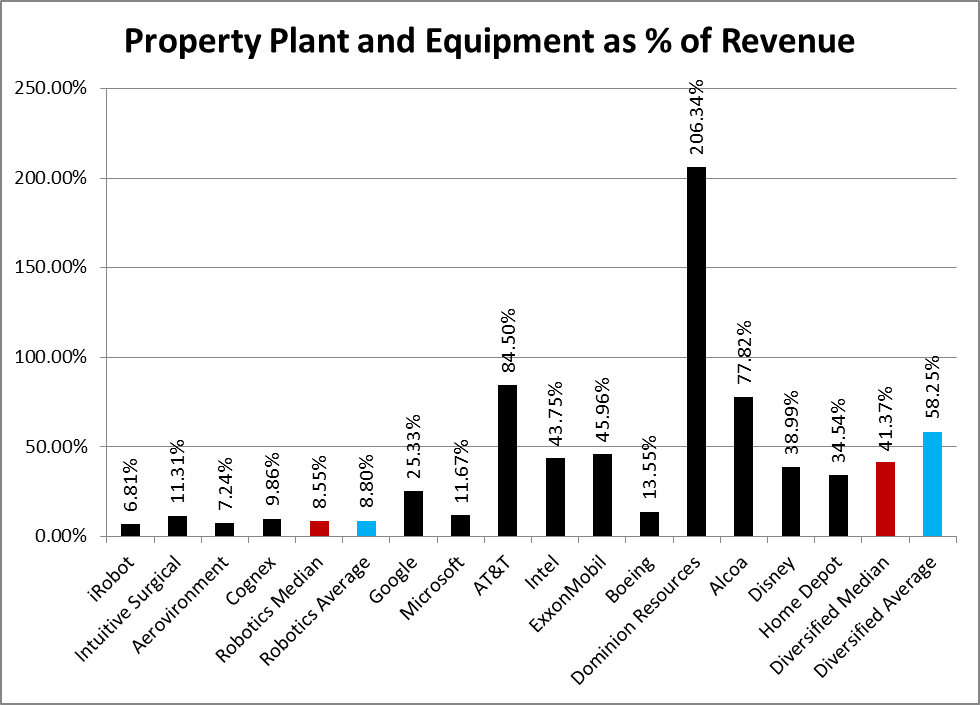
Please allow me to blow your mind and overturn the common sense notion that robotics companies are capital intensive. Comparing profitable, public, U.S. based robotics companies to a diverse basket of prominent public companies shows that robotics companies do not require a lot equipment and property to make successful businesses.
In fact, robotics companies have the least property plant and equipment of any of the companies I selected for comparison–which deliberately included such tech giants as a chip maker, an operating system maker, and a search engine giant. Looking at capital expenditure and depreciation, the robotics companies are again among the leanest of the companies on the list.
The only companies that had such low numbers for CAPEX and depreciation had their assets tied up in very long term investments like real estate and aircraft manufacturing facilities. Also, most of the robotics companies are still growing and may have their capital expenditures boosted as a percentage of revenues by their anticipated growth. Take a look at the trend line.
Now what people may mean when they say that robotics is ‘capital intensive’ is that the marginal cost of goods sold for a robotics company is greater than $0/per unit that consumer web applications have–but if that’s what they mean they should come out and say it and not be sloppy in their reasoning.
Angels, VCs, and other investors are you paying attention? Big plays are going to be made on relatively small bets.


|
|
As a Percentage of Revenue |
| Ticker |
Company
|
PPE |
Depreciation |
CAPEX
|
|
|
|
|
|
|
Robotics
|
|
|
|
|
|
IRBT
|
iRobot
|
6.81%
|
2.42%
|
3.05%
|
|
ISRG
|
Intuitive Surgical
|
11.31%
|
1.68%
|
6.79%
|
|
AVAV
|
Aerovironment
|
7.24%
|
2.76%
|
4.61%
|
|
CGNX
|
Cognex
|
9.86%
|
1.72%
|
2.43%
|
|
Robotics Median
|
8.55%
|
2.07%
|
3.83%
|
|
Robotics Average
|
8.80%
|
2.14%
|
4.22%
|
|
|
|
|
|
| Diversified |
|
|
|
|
GOOG
|
Google
|
25.33%
|
3.68%
|
9.07%
|
|
MSFT
|
Microsoft
|
11.67%
|
3.95%
|
3.37%
|
|
T
|
AT&T
|
84.50%
|
14.50%
|
15.87%
|
|
INTC
|
Intel
|
43.75%
|
9.52%
|
19.93%
|
|
XOM
|
ExxonMobil
|
45.96%
|
3.34%
|
6.63%
|
|
BA
|
Boeing
|
13.55%
|
2.12%
|
2.36%
|
|
D
|
Dominion Resources
|
206.34%
|
8.96%
|
25.40%
|
|
AA
|
Alcoa
|
77.82%
|
5.94%
|
5.16%
|
|
DIS
|
Disney
|
38.99%
|
4.50%
|
7.32%
|
|
HD
|
Home Depot
|
34.54%
|
2.39%
|
1.65%
|
|
Diversified Median
|
41.37%
|
4.23%
|
6.98%
|
|
Diversified Average
|
58.25%
|
5.89%
|
9.68%
|
Some notes on the analysis:
-Data comes from the companies last 10-K filing. Some companies include different things in revenue (where possible I tried to exclude revenue from a financing arm), in deprecation (some include amortization of intangible assets), and capital expenditure (Intuitive, for example, includes the acquisition of intangible assets).
-I wanted to look at a diverse basket of public companies and tried to pick companies that might be similar in some ways to robotics companies but whose earnings would not be unduly influenced by robotic related income. For example, I excluded offshore oil field services companies because they were too close to being robotics companies, but still not pure enough to get a good view of the diversified company. I did include Disney (which does anamatronics), Boeing (which has a UAV making subsidiary), and Google (which has a robotic car division) because I thought the revenues contributed to the these companies by robotics related activities had no material impact on the financial metrics. However, their tangential involvement in robotics speaks to their similarity to robotics businesses.
-Future analysis should look at some other places where capital use can be buried. For example, Cost of Goods Sold can hide capital that is employed on the companies behalf further up the supply chain. It is possible that current assets like inventory may also need to be higher for robotics companies. Also, we should compare total assets and liabilities to the revenue generated to similarly sized public companies to see if there is a substantial difference.



 robocosmist
East Coast Chauvinism in Robotics: Time to Face Facts, Silicon Valley is Kicking Our Ass
2012/06/24 by Robert Morris Leave a comment
A cleaned-up version of this article became my first post on Hizook. http://www.hizook.com/blog/2012/06/25/east-coast-chauvinism-robotics-time-face-facts-silicon-valley-kicking-our-butt#comment-971
_______
I have lots of love for Pittsburgh in particular, but it really pisses me off when people on the East Coast repeat a bunch of falsehoods (See #8) about how Boston and Pittsburgh compare to Silicon Valley and the rest of the world. Many people in Pittsburgh and Boston—including people I call friends and mentors—smugly think that the MIT and CMU centered robotics clusters are leading the world in robotics. This is demonstrably false.
If leadership in robotics means forming companies, making money, or employing people, then Silicon Valley is crushing everyone—no matter what the Wall Street Journal editorial page says about their business climate. I’ve previously published an analysis of the Hizook 2011 VC Funding in Robotics data that shows that the Valley gets 49% of total VC robotics investment worldwide.
I’d now like to add an analysis of U.S. public companies (see bottom of the page). Basically, the ‘Pittsburgh and Boston are the center of the robotics world’ story is even more ridiculous if you look at where public robotics companies are located. Silicon Valley is crushing the other clusters in the U.S. at creating value in robotics and in building a robotics workforce in public companies. (A forthcoming analysis will show that this true worldwide and if you include robotics divisions of public companies not principally engaged in robotics such as Boeing and Textron.)
77% of the workforce at public robotics pure plays is in Silicon Valley companies. An astounding 93% of the market capitalization is headquartered in Silicon Valley and even if you exclude Intuitive Surgical (NASDAQ:ISRG) as an outlier, the Silicon Valley cluster still has twice as much market capitalization as Boston.
The public companies that I deemed to meet the criteria of being principally engaged in robotics, that they had to make and sell a robot, and not have substantial value creating revenues from businesses not related to robotics are listed in the table below.
The one company that I believe might be controversial for being excluded from this list is Cognex (NASDAQ:CGNX). However, while trying to do decide on whether to include them, I found their list of locations. They have three locations in California including two in Silicon Valley. That means that this ‘Boston’ company has more offices in Silicon Valley than in Boston. I’m not an advanced (or motivated) enough analyst to find out what the exact employee breakdown is, but combined with the fact that they make vision systems and supply components rather than robots, I elected to exclude them. I acknowledge that a similar case could be made about Adept (NASDAQ:ADEP) that just made a New Hampshire acquisition, but I have decided to include them and count them towards Silicon Valley. I do not believe that either of these decisions, substantively impact my finding that Silicon Valley is the leading cluster when it comes to public company workforce and value creation.
I’m hoping the people who are spreading the misinformation that Silicon Valley has to catch-up to Boston and Pittsburgh will publish corrections. I believe that this is important, particularly because I want to see Pittsburgh reclaim its early lead in robotics. So many robotic inventions can trace their heritage back to Pittsburgh, it is a real shame that Pittsburgh has not used this strength to create the kind of robotics business ecosystem that one would hope.
It is impossible for communities to take appropriate action if they do not understand where they stand. I hope that this new data will inspire the Pittsburgh community to come together and address the challenges of culture, customer access, and capital availability that have been inhibiting the growth of Pittsburgh’s robotic ecosystem before they lose too many more aspiring young entrepreneurs—such as me—to the siren song of California.
1,100
463
20%
2%
183
43
3%
0%
768
577
14%
2%
174
135
3%
1%
1,924
21,840
36%
88%
619
606
12%
2%
429
1,110
8%
4%
171
13
3%
0%
5,368
24,787
100%
100%
Filed under Clusters, Commentary, Economics, Finance, Public Companies Tagged with Boston, business, California, Clusters, drones, economic, Equity, financing, hizook, market capitalization, New England, Public Securities, robotics, Silicon Valley, Stock, VC, Venture Capital, workforce