2012/07/01
by Robert Morris
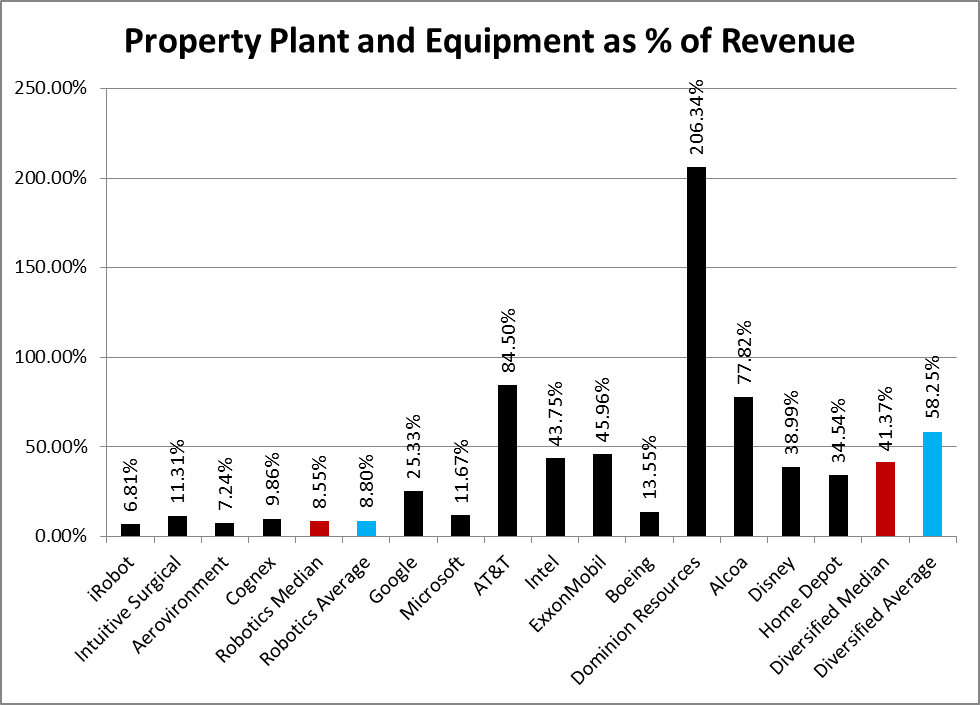
Please allow me to blow your mind and overturn the common sense notion that robotics companies are capital intensive. Comparing profitable, public, U.S. based robotics companies to a diverse basket of prominent public companies shows that robotics companies do not require a lot equipment and property to make successful businesses.
In fact, robotics companies have the least property plant and equipment of any of the companies I selected for comparison–which deliberately included such tech giants as a chip maker, an operating system maker, and a search engine giant. Looking at capital expenditure and depreciation, the robotics companies are again among the leanest of the companies on the list.
The only companies that had such low numbers for CAPEX and depreciation had their assets tied up in very long term investments like real estate and aircraft manufacturing facilities. Also, most of the robotics companies are still growing and may have their capital expenditures boosted as a percentage of revenues by their anticipated growth. Take a look at the trend line.
Now what people may mean when they say that robotics is ‘capital intensive’ is that the marginal cost of goods sold for a robotics company is greater than $0/per unit that consumer web applications have–but if that’s what they mean they should come out and say it and not be sloppy in their reasoning.
Angels, VCs, and other investors are you paying attention? Big plays are going to be made on relatively small bets.


|
|
As a Percentage of Revenue |
| Ticker |
Company
|
PPE |
Depreciation |
CAPEX
|
|
|
|
|
|
|
Robotics
|
|
|
|
|
|
IRBT
|
iRobot
|
6.81%
|
2.42%
|
3.05%
|
|
ISRG
|
Intuitive Surgical
|
11.31%
|
1.68%
|
6.79%
|
|
AVAV
|
Aerovironment
|
7.24%
|
2.76%
|
4.61%
|
|
CGNX
|
Cognex
|
9.86%
|
1.72%
|
2.43%
|
|
Robotics Median
|
8.55%
|
2.07%
|
3.83%
|
|
Robotics Average
|
8.80%
|
2.14%
|
4.22%
|
|
|
|
|
|
| Diversified |
|
|
|
|
GOOG
|
Google
|
25.33%
|
3.68%
|
9.07%
|
|
MSFT
|
Microsoft
|
11.67%
|
3.95%
|
3.37%
|
|
T
|
AT&T
|
84.50%
|
14.50%
|
15.87%
|
|
INTC
|
Intel
|
43.75%
|
9.52%
|
19.93%
|
|
XOM
|
ExxonMobil
|
45.96%
|
3.34%
|
6.63%
|
|
BA
|
Boeing
|
13.55%
|
2.12%
|
2.36%
|
|
D
|
Dominion Resources
|
206.34%
|
8.96%
|
25.40%
|
|
AA
|
Alcoa
|
77.82%
|
5.94%
|
5.16%
|
|
DIS
|
Disney
|
38.99%
|
4.50%
|
7.32%
|
|
HD
|
Home Depot
|
34.54%
|
2.39%
|
1.65%
|
|
Diversified Median
|
41.37%
|
4.23%
|
6.98%
|
|
Diversified Average
|
58.25%
|
5.89%
|
9.68%
|
Some notes on the analysis:
-Data comes from the companies last 10-K filing. Some companies include different things in revenue (where possible I tried to exclude revenue from a financing arm), in deprecation (some include amortization of intangible assets), and capital expenditure (Intuitive, for example, includes the acquisition of intangible assets).
-I wanted to look at a diverse basket of public companies and tried to pick companies that might be similar in some ways to robotics companies but whose earnings would not be unduly influenced by robotic related income. For example, I excluded offshore oil field services companies because they were too close to being robotics companies, but still not pure enough to get a good view of the diversified company. I did include Disney (which does anamatronics), Boeing (which has a UAV making subsidiary), and Google (which has a robotic car division) because I thought the revenues contributed to the these companies by robotics related activities had no material impact on the financial metrics. However, their tangential involvement in robotics speaks to their similarity to robotics businesses.
-Future analysis should look at some other places where capital use can be buried. For example, Cost of Goods Sold can hide capital that is employed on the companies behalf further up the supply chain. It is possible that current assets like inventory may also need to be higher for robotics companies. Also, we should compare total assets and liabilities to the revenue generated to similarly sized public companies to see if there is a substantial difference.




 robocosmist
Hiring Ads: Sign of strength in job market or weakness of informal networks?
2012/07/08 by Robert Morris Leave a comment
There is an interesting post on hiring ads over at Global Robotics Innovation Park. The post sources its data from Wanted Analytics’s post on hiring advertising for robotics. The post headline is that robotics related hiring ads are up 29%. This is good news, but I’m not sure that it is that significant a statement on the health of our industry. It is more a statement on the health of our industry’s customers and the macro-economy at large.
If you look at the trend and the details that they report, it seems that most of these jobs are at users of robotics in manufacturing or medical hubs–not places with lots of robotics builders. The need for a physician/urologist with robotics experience sounds a lot like hospitals are trying to keep those sweet new DaVinci Sis fully utilized. A lot of the other jobs sound like manufacturing is finally finding its feet again. Don’t get me wrong, this is all good for robotics, but it doesn’t mean that our industry is growing relative to the economy at large. Take a look at the job posting numbers for robotics qualifications.
Job Postings for Robotics:
Image Source: http://www.wantedanalytics.com
Wanted Analytics also has a similar post on the state of hiring for lean six sigma engineers with a headline about 28% growth. The trend of the two graphs is almost identical. This suggests to me that both the headlines should really be about the macro-economy and what that means for hiring.
Job Postings for Lean Six Sigma:
Image Source: http://www.wantedanalytics.com
I think the takeaway from this jobs post is that as our industry continues to insert robotics into more areas of people’s lives, that the changes will not be in tech hubs where robots are designed and built. Rather, the changes will be where the users live. Our impact, for good or ill will be where our systems get used. Adoption and sales are going to be driven by the challenges that our customers face. As an industry we need to start addressing the challenges of the robotics workforce to remove that impediment to adoption. ReThink Robotics is on the right track trying to reduce the hurdles to operating a robot. Still, our society will probably require a lot of system operators and maintainers if more work is to be done by robotic systems. The education system is unlikely to meet this challenge with out partners, I hope that our industry can be such a partner.
Filed under Commentary, Economics