A response to Singer

I must be an Aristotelian active soul, because I have no patience for those who hold themselves up as philosophers but suggest no way to actually live in the world.  I have a new post up on Hizook taking the leading intellectual on drones to task for sloppy reasoning–then I suggest a realistic path forward.

http://www.hizook.com/blog/2012/07/23/pw-singer-wastes-opportunity-atlantic

Hizook 2011 Notes

Be on the look out for a forthcoming analysis of the Hizook 2011 VC in Robotic List on Hizook about the funds that invest in robotics.   I’m publishing my research notes here so they don’t foul up the article.  Most of this was sourced from company websites, CrunchBase, local media, or whatever I could find using Google with my limited attention span, I think I even remembered to cite a few as I was making this.

The only thing I’d really like to call your attention to, dear reader, is the complete lack of transparency in the private markets.  You’ll see that there are places I could find a round, or an amount, or fund but nothing else.  A lot of the poor citation is me trying to find a better source.  Private transactions have no organized data so if this can be the faintest candle for finding funding for robotics, then I’ve done my job.

As always, I’d love feedback.  I’m hungry for data!

More Hacker Spaces! Techshop coming to Pittsburgh

Techshop is coming to Pittsburgh.  This will be a great addition to Pittsburgh’s DIY / Hacker culture–which has a slightly different flavor in Pittsburgh because-unlike the big coastal cities that are ‘rediscovering’ the idea of building stuff-Pittsburgh is a city that never stopped thinking of itself as working, industrial city.   On a personal level, I’m excited that Techshop is coming to Pittsburgh with a focus on veterans.

I’m not sure how we should view these kinds of DIY/Hacker spaces in terms of the robotics ecosystem.  Off the top of my head, I can’t think of any successful start-ups that got their start in these kinds spaces.  If you look at the hacker space websites, the kinds of projects that they tout as commercial successes are more in the consumer device space (e.g. artistic iPhone docks)  as opposed to commercial robotics.  On the other hand, they seem to be a good marker of the kind of culture that builds robots.  So whether this is indicative or causative of a great robotics scene, welcome to Pittsburgh, Techshop.

As an aside: I’ve updated the cluster comparison with a few of these developments and more DIY/Hackerspaces.  There are links in the cluster comparison to several resources in this arena.

Where are the Ops Companies?

Really where are they?  Given how many companies are  building some form of robot it seems like there should be some proportionally greater number of companies out there forming to implement, service, and operate these robots.  Where are they?

Frank Tobe isn’t finding a lot of them forming in his start-up list.  Even the RIA seems to have fewer integrators than suppliers.  AUVSI has many more Lockheeds and Insitus than VT Services.  One could make a case that this is characteristic of the peculiar industries that we’re looking at.  The robotic counter example is perhaps the ROV industry which routinely provides the ROV as a packaged service to the off-shore oil and gas industry.  But most consumer robotics are still selling to early adopters.  Our consumer customers are all people who want tech for tech’s sake, not to mainstream customers that are just looking to solve a problem.

Think about other complex goods in our economy.  Computers have a vast cottage industry associated with servicing and maintaining them which is probably as big or bigger than the software industry proper.  All vehicle industries whether air, ground, or sea have vastly more businesses in the business of selling the services than engaged in construction of the vehicles–even if constructors do manage to capture a large share of the total revenues of the industry.

I think our industry has a problem.  I’ve talked to people at the oil and gas majors and heard straight out that robotics companies are producing robots which have a business case to be used several applications, but they will never be used until a credible organization to is there to provide the robot as a service.   It is a bit of chicken and egg, but I think this applies as you go down the chain, not just in large capital projects.

When doing sampling or reconnaissance, customers want actionable data not a fleet of robots or new employees.  I know from experience that infantry brigade commanders love having drone imagery of the battlefield, but don’t want to worry about having to support the drone unit, they just want to see the battle.  This is equally true in forestry, agriculture, infrastructure, and minerals.

Do I really want to own a cleaning robot? No, I would much rather have a business that comes to my house every week and keeps the place clean whether that business uses humans, robots, or both.

Even in medicine, if I were a hospital operator I’d love to be able to push the risk of owning the robot back onto someone else.  If I can pay per procedure and not worry about utilization, maintenance, or obsolescence–I’m much more game to adopt something new.

To date, our industry has done a relatively poor job of making robotics accessible to people and organizations who aren’t willing to organize around robotics and develop organizational competence in robotics.  Providing robotics as a service could greatly expand the number of potential customers.  I think when we see these businesses start cropping up, we will know that our industry is no longer in its infancy.

What cluster does a company with HQ in Boston but more offices in Silicon Valley belong to?

I’ve got more comprehensive data on public robotics companies due to some updates suggested over at hizook.  However, I’m at a loss as to how to classify Brooks Automation and Cognex.  They both make automation components for various kinds of industrial applications and they both have corporate HQ outside of Boston with two offices each (probably the legacy of acquisitions) in Silicon Valley.

At a loss as to how to classify them, I’ve made a new category for them on my charts.  If you have thoughts about how to get good acquisition data–especially as a lot robotics companies can be acquired in a transaction that is ‘immaterial’ to a 10-K/Q for public company–I’d love to hear them.

And here is the raw data.  Not all market caps were taken on the same day.

Surprise! Robotics Companies Are NOT Capital Intensive

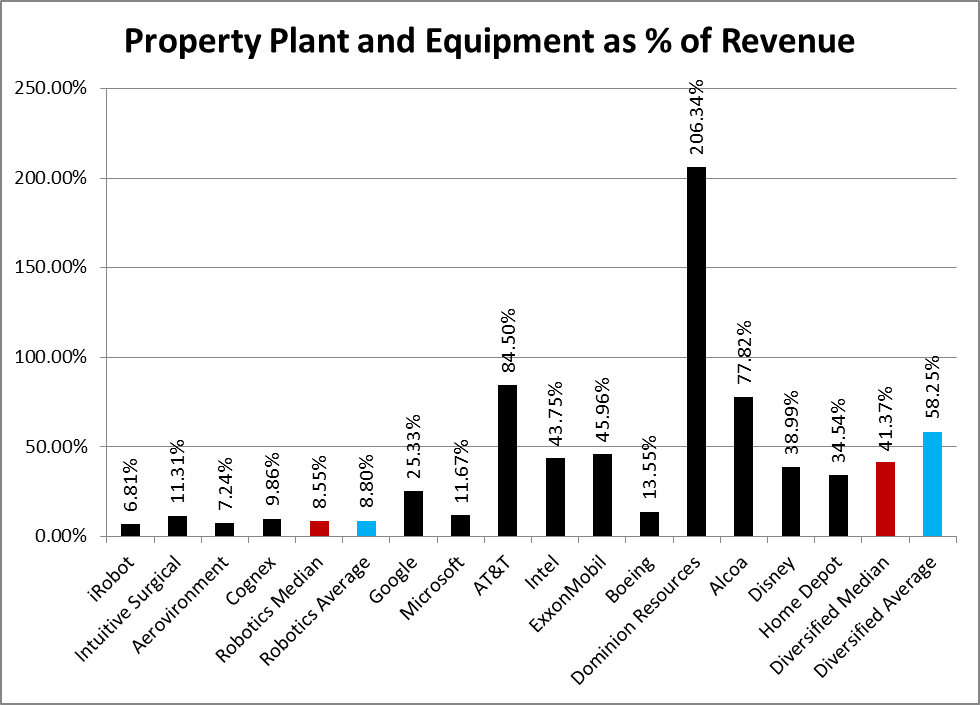
Please allow me to blow your mind and overturn the common sense notion that robotics companies are capital intensive.  Comparing profitable, public, U.S. based robotics companies to a diverse basket of prominent public companies shows that robotics companies do not require a lot equipment and property to make successful businesses.

In fact, robotics companies have the least property plant and equipment of any of the companies I selected for comparison–which deliberately included such tech giants as a chip maker, an operating system maker, and a search engine giant.  Looking at capital expenditure and depreciation, the robotics companies are again among the leanest of the companies on the list.

The only companies that had such low numbers for CAPEX and depreciation had their assets tied up in very long term investments like real estate and aircraft manufacturing facilities.  Also, most of the robotics companies are still growing and may have their capital expenditures boosted as a percentage of revenues by their anticipated growth.  Take a look at the trend line.

Now what people may mean when they say that robotics is ‘capital intensive’ is that the marginal cost of goods sold for a robotics company is greater than $0/per unit that consumer web applications have–but if that’s what they mean they should come out and say it and not be sloppy in their reasoning.

Angels, VCs, and other investors are you paying attention?  Big plays are going to be made on relatively small bets.

As a Percentage of Revenue
Ticker

Company

PPE Depreciation

CAPEX

Robotics

IRBT

iRobot

6.81%

2.42%

3.05%

ISRG

Intuitive Surgical

11.31%

1.68%

6.79%

AVAV

Aerovironment

7.24%

2.76%

4.61%

CGNX

Cognex

9.86%

1.72%

2.43%

Robotics Median

8.55%

2.07%

3.83%

Robotics Average

8.80%

2.14%

4.22%

Diversified

GOOG

Google

25.33%

3.68%

9.07%

MSFT

Microsoft

11.67%

3.95%

3.37%

T

AT&T

84.50%

14.50%

15.87%

INTC

Intel

43.75%

9.52%

19.93%

XOM

ExxonMobil

45.96%

3.34%

6.63%

BA

Boeing

13.55%

2.12%

2.36%

D

Dominion Resources

206.34%

8.96%

25.40%

AA

Alcoa

77.82%

5.94%

5.16%

DIS

Disney

38.99%

4.50%

7.32%

HD

Home Depot

34.54%

2.39%

1.65%

Diversified Median

41.37%

4.23%

6.98%

Diversified Average

58.25%

5.89%

9.68%

Some notes on the analysis:

-Data comes from the companies last 10-K filing.  Some companies include different things in revenue (where possible I tried to exclude revenue from a financing arm), in deprecation (some include amortization of intangible assets), and capital expenditure (Intuitive, for example, includes the acquisition of intangible assets).

-I wanted to look at a diverse basket of public companies and tried to pick companies that might be similar in some ways to robotics companies but whose earnings would not be unduly influenced by robotic related income.  For example, I excluded offshore oil field services companies because they were too close to being robotics companies, but still not pure enough to get a good view of the diversified company.  I did include Disney (which does anamatronics), Boeing (which has a UAV making subsidiary), and Google (which has a robotic car division) because I thought the revenues contributed to the these companies by robotics related activities had no material impact on the financial metrics.  However, their tangential involvement in robotics speaks to their similarity to robotics businesses.

-Future analysis should look at some other places where capital use can be buried.  For example, Cost of Goods Sold can hide capital that is employed on the companies behalf further up the supply chain.  It is possible that current assets like inventory may also need to be higher for robotics companies.  Also, we should compare total assets and liabilities to the revenue generated to similarly sized public companies to see if there is a substantial difference.

Before we can even have a bubble in robotics…

Our industry needs a better methodology for managing robotics development.

I just a had a great entrepreneurship conversation.  My entrepreneur friend opened my eyes to the possibilities for robotics in an industry, platform space, and application that I had pretty much written off.  The application was using robots to collect data–the simplest and earliest task for any class of robots.  He had taken a fresh look at an industry he knew intimately and seen that there was an opportunity to do something extraordinary and make some money.

This friend is not a robotics expert, but he’s been awakened to the potential in the robotics field.  His big concern and great hesitancy to  jumping into this business is establishing a workable business model.  He sees the potential in the opportunity with the vividness of an insider, but when it comes to the robotics he could use, he sees the immature, expensive junk of an outsider’s eye.  He’s vividly aware of the danger he might not structure the business or implement the technology in such a way as to be the guy who becomes profitable and grows first.  He saw that it would take a lot of money and time just to prove out the concept and that it might take much longer to figure out the right business model.  Meanwhile, his fledgling robotics company would be burning cash at the combined rate of a software, hardware, and an operations company with a direct sales force–not a very pretty proposition.

I didn’t really have anything to say to him on that front other than hackneyed cliches about iterating, pivoting, and the value of moving early.  It really occurs to me that my friend is already following what little we know about how to build a robotics company.  Be a great whatever-you-are first (medical device, logistics solution, toy, etc.) then have it be a robot.   Don’t market the thing as a robot; market it as a new technology solution to a real problem that is worth money to solve.  Be willing it iterate (fail on first attempts).  Go to market with the least capability that you can get paid any money at all for.   All great principles, but it seems like we’re still missing the kind of prescriptions that have developed for software.

The Lean Start-up movement, combined with movements like Agile Development have brought much more rigor to how software development in early stage companies is managed.  More traditional software and engineer models are still applicable to projects where the desired outcome is well known.  In most of my conversations with engineers, it seems like robotics engineering has not reached a similar stage of maturity.  It is difficult for robotics engineers to communicate to business leaders when they will know something that allows for opportunities in business decision making, let alone accurately forecast the true cost of a development job.

The most successful robotics companies do a great job managing development.  However, when you talk to their founders or engineering leads, they are often at a loss to explain what they did differently from failed efforts.  They might explain how they avoided some basic pitfalls–like outsourcing design work–but they often have a very difficult time offering an affirmative description of what they did, why it worked, and how they kept the engineering process and the business on track towards the correct goal.  If robotics is ever going to be the semi-conductors of the 80’s, web of the 90’s, or social and mobile of today, our industry will need to develop a compelling description of how to stay on track towards successful technology and business outcomes.

Pittsburgh has a robotics meet-up!

Time to update the cluster comparison statistics, Pittsburgh has a robotics meet-up!  Join the AUVSI crew for some whiskey tasting.  I’ll be disappointed to be out in the Valley on Monday night.

http://www.meetup.com/Pittsburgh-Robotics/

East Coast Chauvinism in Robotics: Time to Face Facts, Silicon Valley is Kicking Our Ass

A cleaned-up version of this article became my first post on Hizook.  http://www.hizook.com/blog/2012/06/25/east-coast-chauvinism-robotics-time-face-facts-silicon-valley-kicking-our-butt#comment-971

_______

I have lots of love for Pittsburgh in particular, but it really pisses me off when people on the East Coast repeat a bunch of falsehoods (See #8) about how Boston and Pittsburgh compare to Silicon Valley and the rest of the world.  Many people in Pittsburgh and Boston—including people I call friends and mentors—smugly think that the MIT and CMU centered robotics clusters are leading the world in robotics.  This is demonstrably false.

If leadership in robotics means forming companies, making money, or employing people, then Silicon Valley is crushing everyone—no matter what the Wall Street Journal editorial page says about their business climate.  I’ve previously published an analysis of the Hizook 2011 VC Funding in Robotics data that shows that the Valley gets 49% of total VC robotics investment worldwide.

I’d now like to add an analysis of U.S. public companies (see bottom of the page).  Basically, the ‘Pittsburgh and Boston are the center of the robotics world’ story is even more ridiculous if you look at where public robotics companies are located.  Silicon Valley is crushing the other clusters in the U.S. at creating value in robotics and in building a robotics workforce in public companies.  (A forthcoming analysis will show that this true worldwide and if you include robotics divisions of public companies not principally engaged in robotics such as Boeing and Textron.)

77% of the workforce at public robotics pure plays is in Silicon Valley companies.  An astounding 93% of the market capitalization is headquartered in Silicon Valley and even if you exclude Intuitive Surgical (NASDAQ:ISRG) as an outlier, the Silicon Valley cluster still has twice as much market capitalization as Boston.

The public companies that I deemed to meet the criteria of being principally engaged in robotics, that they had to make and sell a robot, and not have substantial value creating revenues from businesses not related to robotics are listed in the table below.

The one company that I believe might be controversial for being excluded from this list is Cognex (NASDAQ:CGNX).  However, while trying to do decide on whether to include them, I found their list of locations.  They have three locations in California including two in Silicon Valley.  That means that this ‘Boston’ company has more offices in Silicon Valley than in Boston.  I’m not an advanced (or motivated) enough analyst to find out what the exact employee breakdown is, but combined with the fact that they make vision systems and supply components rather than robots, I elected to exclude them. I acknowledge that a similar case could be made about Adept (NASDAQ:ADEP) that just made a New Hampshire acquisition, but I have decided to include them and count them towards Silicon Valley.   I do not believe that either of these decisions, substantively impact my finding that Silicon Valley is the leading cluster when it comes to public company workforce and value creation.

I’m hoping the people who are spreading the misinformation that Silicon Valley has to catch-up to Boston and Pittsburgh will publish corrections.  I believe that this is important, particularly because I want to see Pittsburgh reclaim its early lead in robotics.  So many robotic inventions can trace their heritage back to Pittsburgh, it is a real shame that Pittsburgh has not used this strength to create the kind of robotics business ecosystem that one would hope.

It is impossible for communities to take appropriate action if they do not understand where they stand.  I hope that this new data will inspire the Pittsburgh community to come together and address the challenges of culture, customer access, and capital availability that have been inhibiting the growth of Pittsburgh’s robotic ecosystem before they lose too many more aspiring young entrepreneurs—such as me—to the siren song of California.

Company (1) Ticker Employees (2) Market Cap $M (3) % of Employees % of Market Cap Robotics Cluster
Accuray NASDAQ:ARAY

                   1,100

  463

20%

2%

SV
Adept NASDAQ:ADEP

                       183

43

3%

0%

SV
Aerovironment NASDAQ:AVAV

                       768

  577

14%

2%

SV
Hansen NASDAQ:HNSN

                       174

 135

3%

1%

SV
Intuitive Surgical NASDAQ:ISRG

                   1,924

  21,840

36%

88%

SV
iRobot NASDAQ:IRBT

                       619

  606

12%

2%

BOS
MAKO Surgical NASDAQ:MAKO

                       429

  1,110

8%

4%

Other
Stereotaxis Inc. NASDAQ:STXS

                       171

 13

3%

0%

Other
Total

                   5,368

24,787

100%

100%

(1) Companies are U.S. public companies that have been identified by Frank Tobe’s or my own research as principally engaged in robotics
(2) Employee Count as of Last 10-K Filing
(3) Market Capitalization as of 6/24/2012

Who is investing in robotics

Inspired by getting a second e-mail about Grishin Robotics, I was parsing the VC data from Hizook to see who actually does invest in robotics.  I was surprised to see that there are firms that actually make multiple investments in robotics.

1)  The Foundry Group has invested in both Orbotix and the Makerbot.  This makes some sense in that this is the Techstars crew.  They get consumer technology and nerd culture Makerbot and Orbotix both cater to the maker / gadget-lover / nerd-cool market with consumer products.  Although I’m sure that both companies have possibility of being onto something much bigger whether that is distributed 3D printing changing manufacturing or augmented reality games changing the way that we think about the world, they are both at this point in the toy / hobby market.

2)  Draper Fischer Jurvetson shows up once with Heartland Robotics (now Rethink Robotics) and once again through their ‘Midwest’ affiliate Draper Triangle on Aethon‘s latest raise.  You’ll notice that both of these are practical, safe around humans, commercial applications with predictable, well understood businesses as the customers of these robots.

3) Bezos Expeditions also shows up as an investor on Hizook’s list twice.  He (they?) splits the difference by investing in Makerbot Industries and Heartland/Rethink Robotics.  I guess you could deduce a theme around making stuff, but I think that it might have more to do with personal relationships or just what Jeff Bezos thinks is cool as shit.  I know this post is full of links, but take a look at Bezos Expeditions.  Their portfolio is a space company, a fusion company, a 10,000 year clock with no commercial purpose, and a bunch of other really cool stuff that might scare the bejeezus of a regular VC–along with some relatively conventional investments like Air BnB.

I hope that when Grishin Robotics makes investments, it becomes the kind of investor that signals to follow-on investors that companies it chooses are solid and likely to become profitable.  We need more people entering the business of robotics and investing in robotics if this technology is going to reach everyone it should.   I commend Dmitry Grishin on putting his money where his convictions are.