2012/07/01
by Robert Morris
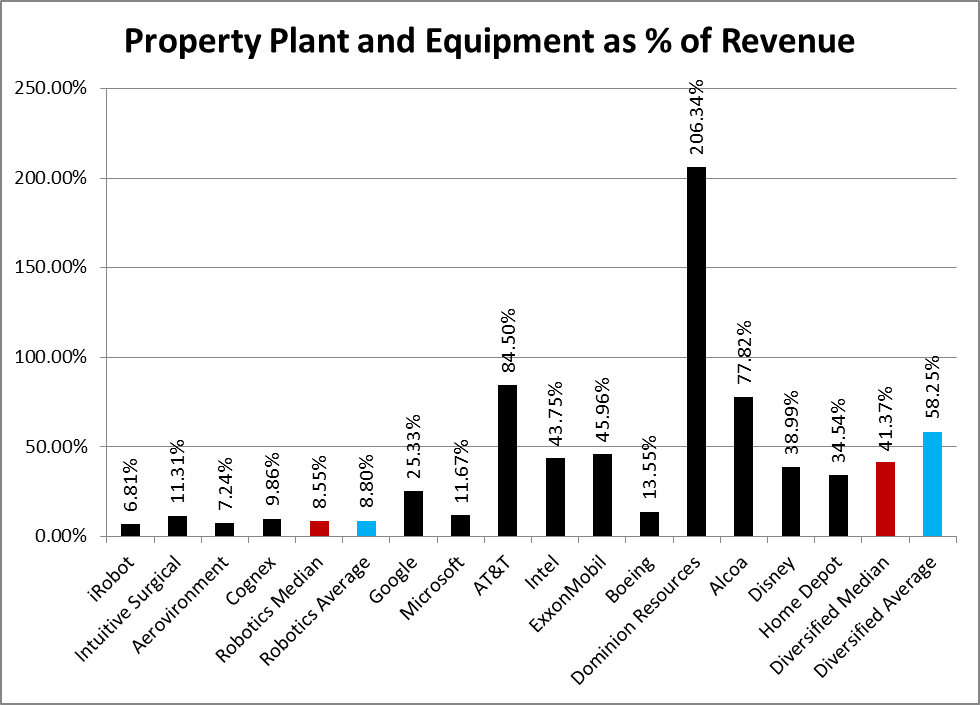
Please allow me to blow your mind and overturn the common sense notion that robotics companies are capital intensive. Comparing profitable, public, U.S. based robotics companies to a diverse basket of prominent public companies shows that robotics companies do not require a lot equipment and property to make successful businesses.
In fact, robotics companies have the least property plant and equipment of any of the companies I selected for comparison–which deliberately included such tech giants as a chip maker, an operating system maker, and a search engine giant. Looking at capital expenditure and depreciation, the robotics companies are again among the leanest of the companies on the list.
The only companies that had such low numbers for CAPEX and depreciation had their assets tied up in very long term investments like real estate and aircraft manufacturing facilities. Also, most of the robotics companies are still growing and may have their capital expenditures boosted as a percentage of revenues by their anticipated growth. Take a look at the trend line.
Now what people may mean when they say that robotics is ‘capital intensive’ is that the marginal cost of goods sold for a robotics company is greater than $0/per unit that consumer web applications have–but if that’s what they mean they should come out and say it and not be sloppy in their reasoning.
Angels, VCs, and other investors are you paying attention? Big plays are going to be made on relatively small bets.


|
|
As a Percentage of Revenue |
| Ticker |
Company
|
PPE |
Depreciation |
CAPEX
|
|
|
|
|
|
|
Robotics
|
|
|
|
|
|
IRBT
|
iRobot
|
6.81%
|
2.42%
|
3.05%
|
|
ISRG
|
Intuitive Surgical
|
11.31%
|
1.68%
|
6.79%
|
|
AVAV
|
Aerovironment
|
7.24%
|
2.76%
|
4.61%
|
|
CGNX
|
Cognex
|
9.86%
|
1.72%
|
2.43%
|
|
Robotics Median
|
8.55%
|
2.07%
|
3.83%
|
|
Robotics Average
|
8.80%
|
2.14%
|
4.22%
|
|
|
|
|
|
| Diversified |
|
|
|
|
GOOG
|
Google
|
25.33%
|
3.68%
|
9.07%
|
|
MSFT
|
Microsoft
|
11.67%
|
3.95%
|
3.37%
|
|
T
|
AT&T
|
84.50%
|
14.50%
|
15.87%
|
|
INTC
|
Intel
|
43.75%
|
9.52%
|
19.93%
|
|
XOM
|
ExxonMobil
|
45.96%
|
3.34%
|
6.63%
|
|
BA
|
Boeing
|
13.55%
|
2.12%
|
2.36%
|
|
D
|
Dominion Resources
|
206.34%
|
8.96%
|
25.40%
|
|
AA
|
Alcoa
|
77.82%
|
5.94%
|
5.16%
|
|
DIS
|
Disney
|
38.99%
|
4.50%
|
7.32%
|
|
HD
|
Home Depot
|
34.54%
|
2.39%
|
1.65%
|
|
Diversified Median
|
41.37%
|
4.23%
|
6.98%
|
|
Diversified Average
|
58.25%
|
5.89%
|
9.68%
|
Some notes on the analysis:
-Data comes from the companies last 10-K filing. Some companies include different things in revenue (where possible I tried to exclude revenue from a financing arm), in deprecation (some include amortization of intangible assets), and capital expenditure (Intuitive, for example, includes the acquisition of intangible assets).
-I wanted to look at a diverse basket of public companies and tried to pick companies that might be similar in some ways to robotics companies but whose earnings would not be unduly influenced by robotic related income. For example, I excluded offshore oil field services companies because they were too close to being robotics companies, but still not pure enough to get a good view of the diversified company. I did include Disney (which does anamatronics), Boeing (which has a UAV making subsidiary), and Google (which has a robotic car division) because I thought the revenues contributed to the these companies by robotics related activities had no material impact on the financial metrics. However, their tangential involvement in robotics speaks to their similarity to robotics businesses.
-Future analysis should look at some other places where capital use can be buried. For example, Cost of Goods Sold can hide capital that is employed on the companies behalf further up the supply chain. It is possible that current assets like inventory may also need to be higher for robotics companies. Also, we should compare total assets and liabilities to the revenue generated to similarly sized public companies to see if there is a substantial difference.



 robocosmist
Where are the Ops Companies?
2012/07/08 by Robert Morris Leave a comment
Really where are they? Given how many companies are building some form of robot it seems like there should be some proportionally greater number of companies out there forming to implement, service, and operate these robots. Where are they?
Frank Tobe isn’t finding a lot of them forming in his start-up list. Even the RIA seems to have fewer integrators than suppliers. AUVSI has many more Lockheeds and Insitus than VT Services. One could make a case that this is characteristic of the peculiar industries that we’re looking at. The robotic counter example is perhaps the ROV industry which routinely provides the ROV as a packaged service to the off-shore oil and gas industry. But most consumer robotics are still selling to early adopters. Our consumer customers are all people who want tech for tech’s sake, not to mainstream customers that are just looking to solve a problem.
Think about other complex goods in our economy. Computers have a vast cottage industry associated with servicing and maintaining them which is probably as big or bigger than the software industry proper. All vehicle industries whether air, ground, or sea have vastly more businesses in the business of selling the services than engaged in construction of the vehicles–even if constructors do manage to capture a large share of the total revenues of the industry.
I think our industry has a problem. I’ve talked to people at the oil and gas majors and heard straight out that robotics companies are producing robots which have a business case to be used several applications, but they will never be used until a credible organization to is there to provide the robot as a service. It is a bit of chicken and egg, but I think this applies as you go down the chain, not just in large capital projects.
When doing sampling or reconnaissance, customers want actionable data not a fleet of robots or new employees. I know from experience that infantry brigade commanders love having drone imagery of the battlefield, but don’t want to worry about having to support the drone unit, they just want to see the battle. This is equally true in forestry, agriculture, infrastructure, and minerals.
Do I really want to own a cleaning robot? No, I would much rather have a business that comes to my house every week and keeps the place clean whether that business uses humans, robots, or both.
Even in medicine, if I were a hospital operator I’d love to be able to push the risk of owning the robot back onto someone else. If I can pay per procedure and not worry about utilization, maintenance, or obsolescence–I’m much more game to adopt something new.
To date, our industry has done a relatively poor job of making robotics accessible to people and organizations who aren’t willing to organize around robotics and develop organizational competence in robotics. Providing robotics as a service could greatly expand the number of potential customers. I think when we see these businesses start cropping up, we will know that our industry is no longer in its infancy.
Filed under Commentary, Economics, Start-ups Tagged with aircraft, cleaning, development, device, drones, financing, medical, risk management, robotics, surgical, survey, technology, unmanned, unmanned systems